


Group tour Vietnam 'on a Shoestring'

TOUR OPERATES:
Day to day description
|
|
Transport |
Route |
Overnight |
|
1 |
Plane |
Departure |
Plane |
|
2 |
Bus, Airplane |
Arrival Hanoi |
Hanoi |
|
3 |
Bus |
Hanoi - Bac Ha |
Bac Ha |
|
4 |
Bus, on foot |
Bac Ha / Sunday market - Ban Luot |
Ban Luot |
|
5 |
|
Ban Luot |
Ban Luot |
|
6 |
Bus |
Ban Luot - Quan Ba |
Quan Ba |
|
7 |
Bus |
Quan Ba - Dong Van |
Dong Van |
|
8 |
Bus |
Dong Van - Meo Vac - Bao Lac |
Bao Lac |
|
9 |
Bus |
Bao Lac - Pac Ngoi |
Pac Ngoi |
|
10 |
Bus |
Pac Ngoi - Hanoi |
Hanoi |
|
11 |
Train |
Hanoi - Hué |
Night train to Hué |
|
12 |
|
Hué |
Hué |
|
13 |
Bus |
Hué - Danang - Hoi An |
Hoi An |
|
14 |
|
Hoi An |
Hoi An |
|
15 |
|
Hoi An |
Hoi An |
|
16 |
Train |
Hoi An - Danang - Ho Chi Minh City |
Night train to Ho Chi Minh City |
|
17 |
|
Ho Chi Minh City / Excursion Tay Ninh and Cu Chi |
Ho Chi Minh City |
|
18 |
Boat, Bus |
Ho Chi Minh City - Cai Be - Vinh Long - Can Tho |
Can Tho (Mekong Delta) |
|
19 |
Bus |
Can Tho - Ho Chi Minh City |
Ho Chi Minh City |
|
20 |
Bus, Airplane |
Departure Ho Chi Minh City |
Plane |
|
21 |
Plane |
Arrival |
Arrival |
Day 1: Departure
You fly to Hanoi where you arrive the next day and your Vietnam tour starts.
Day 2: Arrival Hanoi
You land at Nội Bài International Airport , the airport of Hanoi. Your English speaking tour guide will take you away from the airport. In the evening you can already enter the city. Hanoi has its own unique atmosphere. The various lakes, scattered throughout the city, determine the image. The old colonial villas give the city an unmistakable French touch.
Day 3: Hanoi - Bac Ha
After breakfast you will set off. You make a stop at the Etnological Museum on your round trip Vietnam . On the basis of a large collection of art objects (with an explanation in English, French and Vietnamese), a good picture is sketched of the lives of the 54 ethnic minorities in Vietnam. A good introduction to your exploration of the north of the country (entrance fee not included).
Then you drive further into the mountains to Bac Ha. On the way (in consultation with the tour guide) you can stop for photos. You stay in Bac Ha for two nights in a homestay just outside the town. After arrival you can explore the town. Your dinner is included today.
Day 4: Bac Ha / Sunday market - Ban Luot
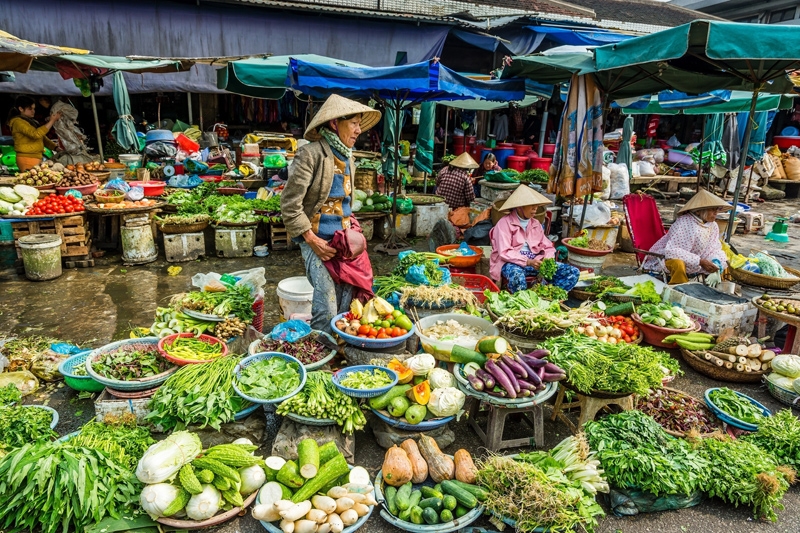
De Zondagmarkt in het minderhedengebied rond Bac Ha wordt voornamelijk bezocht door de Flower H'mong. Deze stam is van oorsprong Chinees en ze worden zo genoemd omdat de vrouwen van deze minderheid zich in bijzonder kleurrijke kledij hullen. Net bloemen! Ook leden van de Rode Dao, Phu La, Zwarte Dao, Tay en Nung bezoeken de markt. Het is, behalve een plek om je spullen te verhandelen, ook een plek om vrienden te ontmoeten. Op de markt kijk je je ogen uit. Er wordt van alles hier verhandeld. Niet alleen groenten, fruit, rijstwijn, tabak, kleding, tassen en huishoudelijke artikelen zijn te verkrijgen, maar ook buffels, stieren, katten, varkens, eenden, kippen en honden. Onder afdakjes wordt eten bereid, waar de marktgangers hun honger kunnen stillen. 'Pho '(noodle soup) is favorite, but there are also more' exotic 'dishes on the menu, in which various types of guts are not lacking.
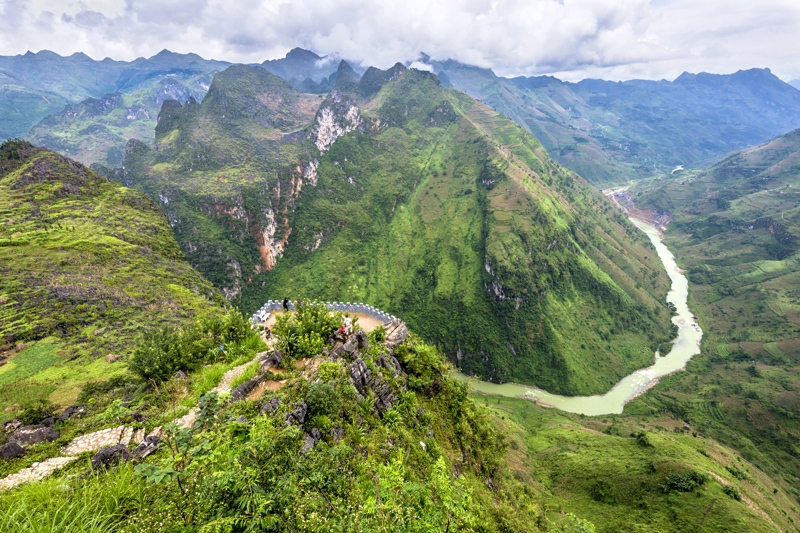
After a visit to the Zondagmarkt you travel across a road full of pits and bumps through the market in Xin Man to Ban Luot. This bumpyroute offers spectacular panoramas , almost shouting for photo stops. You see mountains with rice terraces and deep valleys. The small Hmong villages on the way do not often see passers-by. From the parking lot it is one and a half to two hours walk to Ban Luot, on a path with beautiful views! In Ban Luot you will stay overnight in a homestay, where your dinner is included.
Day 5: Ban Luot
Free day in Ban Luot. The village is famous for its beautiful rice terraces , which have been recognized as ' National Heritage ' by the Vietnamese government . You can walk on one of the most beautiful rice terraces of Northeast Vietnam. You pass rice fields, bamboo forests, a river, waving children riding a buffalo ...
Day 6: Ban Luot - Quan Ba
Again a beautiful route today. The road leads to the most northern province of Ha Giang , through a number of passes known in the region as a meeting place between Heaven and Earth . In the afternoon you check in your homestay in Quan Ba, after which you are free to explore the town for the rest of the day. Dinner is also included today.
Day 7: Quan Ba - Dong Van
Get up early for a refreshing morning walk in the beautiful surroundings of Quan Ba. Today you travel via a (again) photogenic winding road with holes and bumps to the Dong Van Geo-park . Here the imposing limestone cliffs of the karst mountains and the life of the H'Mong people will surely amaze you. Life is really very pure here. On the way you sometimes see people with large branches of forest on their backs, often in traditional clothing. We regularly take photo stops and visit a local village.
In the afternoon you walk with your tour guide through the traditional village of Dong Van, where you can view the local palace of the H'Mong king (admission fee not included). There are French, Chinese and H'Mong styles in the building (1919-1928).
Day 8: Dong Van - Meo Vac - Bao Lac
Through the beautiful Ma Phi Leng pass (beautiful views over the Nho Querivier!) And the charming village of Meo Vac you travel on your Vietnam group trip to Bao Lac. The mountainous area around Bao Lac borders China to the north and is the home area of some 50,000 inhabitants living in small, remote villages , devoid of water supply and electricity. It is one of the poorest regions of Vietnam and also the homeland of the approximately 1000 souls of the Black Lolo people . Their houses stand on stilts in a wide green valley, and also provide shelter for the (plume) cattle. After arrival at the guesthouse you are free to organize your time yourself.
Day 9: Bao Lac - Pac Ngoi
After breakfast you will travel to Pac Ngoi. This village of the Tay people has more than 40 traditional houses on stilts. They lie on a mountainside at the Ba Be lake, the largest freshwater lake in Vietnam. After arrival you check in the homestay and you can organize your time yourself. Your dinner is included today.
You can join an optional excursion in the afternoon where you explore the Ba Be lake and the Nang River. You make a boat trip, and you visit the Dau Dang waterfall and the Puong cave .
Day 10: Pac Ngoi - Hanoi
After breakfast you will travel back to Hanoi. On the way you stop in Thai Nguyen, where you have the opportunity to visit the Duom temple (entrance fee not included). The temple is dedicated to Duong Tu Minh, a talented general under the Ly dynasty (eleventh century). The architecture is influenced by the Vietnamese and Tay culture. After arriving in Hanoi you are free to continue to divide your day.
Day 11: Hanoi - Hué
Day off. The old town, north of Hoan Kiem Lake , consists of numerous small, narrow streets that are inhabited by all kinds of craftsmen. At the shops pans are beaten, leather worked and silk or other were sold. You can wander around here for hours. Do not forget the market in the old center! On the market and the streets around it, many types of rice, tropical fruits, flowers, herbs, vegetables and handicrafts (baskets, bowls) are for sale. Livestock is also displayed for meals, such as dogs, parrots and snakes.
There are several museums that are worthwhile, just like the Temple of Literature and the One-Column Pagoda. The Ho Chi Minh mausoleum you can not miss it (closed on Mondays and Fridays and a few weeks in the autumn in connection with the maintenance of the embalmed body of Ho Chi Minh). If you want to rest from the hustle and bustle of the city, you can do so at a cozy café on the Hoan Kiem lake.
Lovers can participate today in the optional excursion ' Discover 1000 years old Hanoi '.
At the end of the afternoon you will take the night train from Hanoi to Hué ( second class softsleeper , scheduled departure time is 7.30 pm or 8.10 pm, subject to change). The train bears the appropriate name 'Reunification on purpose' , after all, North and South Vietnam become so connected!
Day 12: Hué
Day off. The old emperor city Hué is spatially designed and offers a lot of atmosphere. The most important landmark of this city, surprisingly not having more than 200,000 inhabitants, is the Huong Giang, the 'pleasant-using river or Perfume River'.
You can make an optional excursion on the Perfume River to the imperial tombs and pagodas just outside Hué. The 21 meter high Thien Mu pagoda was built in 1844 and was for a long time the symbol of Vietnam. There is a different Buddha statue on each floor. The Imperial tombs, such as that of the emperors Thien Mu , Minh Mangand Khai Dinh , are scattered in a wavy landscape. There are several photogenic pavilions and see-throughs.
You can also take a look in the vast Forbidden Purple City . Old is not the Forbidden City, the oldest part dates from the beginning of the 19th century from the time of the Nguyen emperors. It is one of the few grand structures from Vietnam's history.
Day 13: Hué - Danang - Hoi An
You continue your journey through Vietnam southward, the ride today is not long, but we will stop a few times along the way. The Cham Museum in Danang has the largest collection of Cham sculpture in the world; the collection has more than 300 sculptures of sandstone. The beautiful Marble Mountains (Ngu Hanh Son) are five hills with caves. At the time of the Vietnam War it was a hiding place for the Viet Cong. Now it is a Buddhist shrine. The many images in the various caves are evidence of this. Entrance fees on the way are not included.
After a nice drive along the coast you arrive in Hoi An, where you spend the night in a hotel with swimming pool. Fine to wash away the tropical heat from you.
Day 14: Hoi An
Day off. Hoi An is a town with traditional houses and is considered by many travelers to be one of the most atmospheric and one of the most attractive places in Vietnam. Visit the photogenic market , with baskets full of exotic fish, shrimps, vegetables or fruit. Numerous old, often wooden houses and historic buildings bear witness to the past. Some of the old Chinese houses are open to visitors. The interior of these houses still looks the same as centuries ago. A number of ancient Chinese temples are still in use.
Who wants to join an optional excursion on the bike to Tra Que. View the fields and help the farmers on the land. Lunch in this herb village consists of various delicacies, such as' tam huu'(spring rolls) or' banh xeo '(traditional pancakes from the Central Vietnam region). You can help the 'chef' with cooking, or watch as the food is prepared.
Day 15: Hoi An
Day off. If you want, you can take a short boat trip on the river or go to the quiet beach of Hoi An on your own. You can choose to cycle in the beautiful surroundings. It is also possible during this Vietnam tour to visit the Cham ruins of My Son , another important cultural-historical heritage of the country.
Day 16: Hoi An - Danang - Ho Chi Minh City
You are traveling to Danang. Here you step for the second time on the 'Reunification Express' night train to Ho Chi Minh City ( second class softsleeper , scheduled departure time is 1:00 pm, subject to change).
NB: You can choose to fly to Ho Chi Minh City (instead of the night train). If you want this, give it up with your booking!
Day 17: Ho Chi Minh City / Excursion Tay Ninh and Cu Chi
Day off. You can explore the city or take part in an optional combined excursion to Cu Chi tunnels and the Cao Dai temple in Tay Ninh.
In Cu Chi you will experience the tunnels excavated by hand (!), Which were used by the Vietcong during the Vietnam War. The complex had a total length of 240 kilometers, divided over several floors with underground hospitals, kitchens and other facilities. You can descend into one of the tunnels to experience a little how people lived, suffered and fought here.
Tay Ninh is the center of the colorful Cao Dai religion. Cao Dai is the product of an attempt to create an ideal religion through the amalgamation of various religions and philosophies of East and West. This has produced an interesting and colorful ideology that currently has around three million supporters, mainly in the Tay Ninh province. At 12 o'clock you can attend a ceremony in the extravagant temple that was once described as an 'Eastern fantasy in the style of Disneyland, with dragons and snakes in technicolor '.
Day 18: Ho Chi Minh City - Cai Be - Vinh Long - Can Tho
You leave Ho Chi Minh City and drive into the green Mekong delta, the 'rice shed' of Vietnam . Here most rice is grown, on a very densely populated piece of land.
How green can you go? TIP
At Cai Be you board a motorboat to Vinh Long. Along the way you will be working at some small-scale workshops where, for example, rice wine, rice paper, rice popcorn or 'keo dua' (coconut candies from thickened coconut milk) are manufactured. You spend the night in a homestay in Can Tho. Your dinner is included today.
Day 19: Can Tho - Ho Chi Minh City
Early birds can optionally go to the Cai Rang floating market . You see large boats here, loaded with merchandise, mainly vegetables or fruit. Small sampans, on which women row with two oars which they operate as in a scissor movement, maneuvering between the large vessels.
Then you drive back to Ho Chi Minh City, the former Saigon. After arrival you are free to dive into the city. A few French colonial buildings have been preserved. Good examples are the City Hall, the Opera and the Notre Dame Cathedral . The Hoofdpostkantoor has been designed by Gustav Eiffel and is still in service. Dong Khoiis the most fashionable street in the city, with stores of famous brands such as Gucci, Armani and Dolce & Gabbana. You can admire the sunset from the 50th floor of the highest building in the city, the Bitexco Financial Tower .
Day 20: Departure Ho Chi Minh City
HCMC is rich in museums, pagodas, temples, colonial buildings and churches. The Giac Lam Pagoda , the oldest in the city, is one of the most important sights. A visit to Cholon, the bustling Chinese district, is definitely recommended. In HCMC are some interesting museums, including the unique Museum of War Memories (formerly known as American War Crimes) and the Historical Museum.
Part of the day you are free, until you transfer to the airport. You fly back to the Netherlands with a switch, where you will arrive full of lively impressions the next day. The time of departure from Ho Chi Minh City depends on your flight schedule.
Day 21: Arrival Home
Travel documents
If you have Dutch or Belgian nationality, you need a visa for Vietnam for this group trip.
More information about your required travel documents (such as passport), your visa, the visa procedure to be followed and the location of the embassy can be found on the website of our partner Visa counter.
We recommend that you apply for your visa 4 to 6 weeks prior to departure from your Vietnam group trip.
If you allow the necessary visa to be arranged via Visumloket, then in addition to the visa costs, € 30, - agency fee per person per visa will be charged. You do not have to go to the relevant embassy (s) twice yourself.
Traveling to a child with a parent with a different surname
When a child is traveling with a parent with a different surname, it can be checked whether there is actually a parent-child relationship. The purpose of this extra check is to prevent child abductions.
Some countries require a statement that the accompanying adult is actually the parent or has the authority. Inquire about this at the embassy or consulate of the country of destination. You can download a permission form on the Royal Netherlands Marechaussee website.
If a child is traveling with someone other than the parents, for example a family member, some countries require a declaration in which the parents give permission for this trip. You can inquire at the embassy or consulate of the country of destination about the admission requirements that apply to this country.

Land arrangement
It is also possible to book only the land arrangement of this tour. You then arrange the international flights yourself and the transfer on arrival and departure. With the other participants you then make the journey according to program. This gives you the freedom to compose your own trip and choose the flight that suits your travel plans.
On the booking form you can also indicate whether we have to arrange an additional night on arrival for an additional fee. The transfer on arrival can also be arranged by Shoestring on an individual basis.
We need a minimum number of participants for all our trips. Keep this in mind before you book your own tickets.
In all cases, it is your responsibility to be present at the starting point of the journey on time. In addition, we are not responsible for sporadic changes in the departure dates of our group trips. For some periods the price of the land arrangement may deviate from the rest of the year, for example festival trips. When the price of the land arrangement is adjusted, this is mentioned under the 'latest news'.
Accommodation and transport
Transport
The entire tour through the country we have access to a good private air-conditioned (mini) bus, so we can also stop at beautiful places in nature. The transfers from and to the airport are included. Any additional transportation costs for optional excursions are not included. On 'free days' the bus is basically not available.
You use the comfortable night train twice: from Hanoi to Hué and from Danang to Ho Chi MInh City. Here you sleep in reserved couchettes in the second class in comfortable beds ( air-conditioned ). A pleasant way to travel these long (and less interesting) travel distances! Breakfast is not included during the night train routes.
Other means of transport? The boat trip at Bai Be in the Mekong Delta is included in your fare. Optionally, you can take a boat trip on the Ba Be lake and the Perfume River at Hué. On site you can rent bikes at several places and there are also plenty of walking opportunities. Fun is also an optional ride per cyclo (bicycle rickshaw). Sufficient variation is transport means, here in Vietnam!
Travel distances from
Hanoi airport to hotel: 30 km / 1 hour
Hanoi to Bac Ha: 300 km / 5 to 6 hours
Bac Ha to Ban Luot: 95 km / 5 hours
Ban Luot to Quan Ba: 155 km / 4 to 5 hours
Quan Ba to Dong Van: 90 km / 3 to 4 hours
Dong Van to Bao Lac: 120 km / 4 hours
Bao Lac to Pac Ngoi: 155 km / 4 hours
Pac Ngoi to Hanoi: 210 km / 4 to 5 hours
Hanoi to Hué; 670 km / 14 hours (night train)
Hué to Hoi An: 130 km / 4 hours
Hoi An via Danang to Ho Chi Minh City: 950 km / 16 hours (night train)
Ho Chi Minh City to Can Tho: 175 km / 4 hours
Can Tho to Ho Chi Minh City: 175 km / 4 hours
Ho Chi Minh City hotel to airport: 7 km / 1 hour
NB: The mentioned 'bare' travel time per day is heavily dependent on the traffic, the condition of the roads and the weather . The travel time is of course approximate.
Accommodation
During the tour we stay in middle class hotels and guesthouses in double rooms, with private bathroom. Your stay is based on bed and breakfast. Most hotels have their own restaurant and sometimes a garden or a terrace. Check-out time at the hotels is usually 12.00, check-in time is usually 14.00.
You stay in five places in a simple, atmospheric homestay , namely Bac Ha, Ban Luot, Quan Ba, Pac Ngoi and Can Tho. These homestays are simple (especially in North Vietnam), but that is part of it if you want to travel to non-tourist areas. No reason to leave it! You sleep in the homestaysin a communal dormitory, and the bathroom is shared. With large groups (from around 16 people) the group is divided over two ' homestays' . There are mosquito nets, blankets and pillows available. However, you are advised to take care of a sleeping bag and a sheet bag yourself. In the homestays the breakfasts and the dinner are included in the fare (drinks are exclusive).
The accommodation in Ban Luot can not be reached by bus because of its unique location; the village is about 1.5 to 2 hours walk from the main road. The walk leads over a beautiful route with very beautiful views! It may be useful to make the day before a daypack with stuff for the two nights in Ban Luot, so you can leave the 'big' luggage in the locked bus. You only have to carry your daypack. If you want to take your large baggage with you or do not want to / can walk, you can rent a moped (at your own expense!). Your tour guide can assist you with this.
The planned hotel in Hoi An has a swimming pool; nice to wash off the tropical heat from you! In exceptional cases it may happen that another hotel without a pool has to be used. If this occurs, we will try to find a suitable alternative.
Wifi is pleasant for many travelers to keep in touch with the home front via 'social media' . The planned hotels have Wi-Fi, sometimes for a fee, sometimes only in the lobby or bar of the hotel. Keep in mind that the quality and speed of the internet connection are certainly not optimal everywhere. In most homestays no wifi is available.
Travelers who - as many - individually register for a trip, share a double room with someone else. We naturally take into account that you come to the room of the same sex. If you want a room for yourself the whole trip, then that can in principle be arranged. You pay the single room surcharge for this. There is no single room in the night trains and the homestays .
Travel guidance
Our trips are accompanied by well-trained local English speaking tour guides (in one case by Dutch-speaking travel guidance). We notice that our travelers greatly appreciate this, especially because these tour guides, in contrast to many of their Dutch colleagues, have more detailed knowledge of their country. He / she knows the area well, can give background information and ensures that the trip goes well. He / she knows how to act when something goes wrong, but is not a walking encyclopaedia. For that we would like to refer to a good travel manual.
Your tour guide expects a tip at the end, if she / he has done the job well. Shoestring pays the tour guides a wage that is on par with that of most adventurous travel organizations. Our guideline for the tip is € 1, - to € 2, - per traveler per day.
Difficulty
We often get the question whether a trip is 'heavy'. We find this a difficult question because the experience of the gravity of a journey is very personal. To give you an idea of the gravity of a trip, we have developed the following point system:
Category A: Light journey, for everyone to do well. Short travel distances, good hotels, travel at a low pace.
Category B: Good for everyone. Sometimes longer travel distances. Good hotels or camping facilities, sometimes adventurous accommodation, travel at an ordinary pace.
Category C: Good to do for everyone who prepares and is flexible. There are heavier trajectories in the journey, such as longer distances or walking routes. Multiple nights in simple accommodation.
Category D: Reasonably demanding journey through long journeys, usually primitive accommodation or tents and brisk walking tours.
The Vietnam trip falls into category: C. These journeys can be made for every fit person. You stay in a few places in a simple, atmospheric homestay. These homestays are simple (especially in North Vietnam), but that is part of it if you want to travel to non-tourist areas. No reason to leave it! You sleep in the homestays in a communal dormitory, and the bathroom is shared. The homestay in Ban Luot has a unique location and you will reach a hefty but beautiful walk. Keep in mind that the journey goes through a developing country, with a much lower standard of living than what you are used to at home. It is also possible that due to the weather or poor road maintenance roads are temporarily impassable and we have to deviate from the route. A flexible and positive attitude is therefore more important than physical fitness. Go especially rested on a journey.

