


Group tour Vietnam & Cambodia

TOUR OPERATES: Group tour Vietnam & Cambodia
Day to day description
|
|
Transport |
Route |
Overnight |
|
1 |
Plane |
Departure Amsterdam |
Plane |
|
2 |
Bus, Airplane |
Arrival Hanoi |
Hanoi |
|
3 |
|
Hanoi |
Hanoi |
|
4 |
Boat, Bus |
Hanoi - Ha Long Bay |
Ha Long Bay |
|
5 |
Boat, Bus, Train |
Ha Long Bay - Hanoi - Hué |
Night train to Hué |
|
6 |
|
Hué |
Hué |
|
7 |
Bus |
Hué - Da Nang - Marble Mountains - Hoi An |
Hoi An |
|
8 |
|
Hoi An / Excursion Tra Que |
Hoi An |
|
9 |
|
Hoi An / Excursion My Son |
Hoi An |
|
10 |
Bus, Train |
Hoi An - Da Nang - Ho Chi Minh City |
Night train to Ho Chi Minh City |
|
11 |
|
Ho Chi Minh City |
Ho Chi Minh City |
|
12 |
|
Ho Chi Minh City / Excursion Excursion Tay Ninh & Cu Chi |
Ho Chi Minh City |
|
13 |
|
Ho Chi Minh City / Mekong Delta excursion |
Ho Chi Minh City |
|
14 |
Public transport |
Ho Chi Minh City - Phnom Penh |
Phnom Penh |
|
15 |
|
Phnom Penh |
Phnom Penh |
|
16 |
Bus |
Phnom Penh - Udong - Battambang |
Battambang |
|
17 |
Bus |
Battambang - Siem Reap |
Siem Reap (Angkor) |
|
18 |
|
Siem Reap / Angkor |
Siem Reap (Angkor) |
|
19 |
|
Siem Reap / Angkor |
Siem Reap (Angkor) |
|
20 |
Bus, Airplane |
Departure from Siem Reap |
Plane |
Day 1: Departure
Today your group tour starts Vietnam & Cambodia.
Day 2: Arrival Hanoi
You land at Nội Bài International Airport , the airport of Hanoi. Your English speaking tour guide will pick you up from the airport. In the evening you can already enter the city. Hanoi has its own unique atmosphere. The various lakes, scattered throughout the city, determine the image. The old colonial villas give the city an unmistakable French touch. Enjoy your first Vietnamese meal !
Day 3: Hanoi
Day off. The old town, north of Hoan Kiem Lake , consists of numerous small, narrow streets that are inhabited by all kinds of craftsmen . At the shops pans are beaten, leather worked and silk or other were sold. You can wander around here for hours. Do not forget the market in the old center! On the market and the streets around it, many types of rice, tropical fruits, flowers, herbs, vegetables and handicrafts (baskets, bowls) are for sale. Livestock is also displayed for meals, such as dogs, parrots and snakes.
There are several museums that are worthwhile, as well as the Temple of Literature and the One-Column Pagoda . The Ho Chi Minh mausoleum you can not miss it (closed on Mondays and Fridays and a few weeks in the autumn in connection with the maintenance of the embalmed body of Ho Chi Minh). If you want to rest from the hustle and bustle of the city, you can do so at a cozy café on the Hoan Kiem lake. Also a ride per cyclo (bicycle taxi) through the city center is fun.
Lovers can participate today in the optional excursion 'Discover 1000 years old Hanoi' .
Day 4: Hanoi - Ha Long Bay
You travel to the stunningly beautiful nature of Ha Long Bay (the Bay of the Descending Dragon). For centuries the vast area (larger than 1500 km²) has been one of the most important attractions in Vietnam. And rightly so: the whimsical karst rocks that rise steeply from the waters of the Gulf of Tonkin, the more than 3000 islands and bays and the few Chinese junks that still pass, make this region unforgettable. You take a cruise through this fairytale area and also sleep on the boat. The bay has already been declared a UNESCO World Heritage Site twice, in 1994 because of the beauty of the area and six years later because of the biological value. During this boat trip 1x lunch, 1x dinner and 1x breakfast are included.
Day 5: Ha Long Bay - Hanoi - Hué
After breakfast you sail back to the mainland. Even now you can enjoy the hundreds of islands, rocks, caves and hidden beaches.
You drive back to Hanoi, where you can spend some time (depending on your arrival time). At the end of the afternoon you leave with the night train to Hué (second class softsleeper, scheduled departure time is 19.30 or 20.15 hours, subject to change). The train carries the appropriate name 'Reunification Express', as North and South Vietnam become so connected!
Day 6: Hué
After arrival with the night train (at 8.30 am or at 9.40 am, subject to change) you go to your hotel in the old imperial city of Hué and you can organize your time yourself. You can take a look in the vast Forbidden Purple City . Old is not the Forbidden City, the oldest part dates from the beginning of the 19th century from the time of the Nguyen emperors. It is one of the few great buildings from Vietnam history.
Around Hué, in the undulating landscape, lie the imperial tombs from the Nguyen dynasty, which ruled the country from Hué until 1945. Though there were thirteen emperors, only seven were buried in a tomb, because they ruled until their death. The tombs are a sort of miniature palaces, surrounded by green gardens, on a lake or river. Perhaps the most beautiful tombs are those of the emperors Khai Dinh and Minh Mang . Beautiful architecture, vistas ... They adorn UNESCO's World Heritage List . The 21 meter high Thien Mu Pagoda is located on the Perfume River and has seven floors. It was built in 1844 and was for a long time the symbol of Vietnam. You can make an optional excursion on the Perfume River to theimperial tombs and pagodas .
Day 7: Hué - Da Nang - Marble Mountains - Hoi An
You continue your journey through Vietnam to the south, today's ride is not long (only 130 km, 'bare' travel time about three hours), but we will stop a few times along the way. First you go to Da Nang, where you can optionally visit the Cham Museum . The museum has the largest collection of Cham sculpture in the world; the collection has more than 300 sculptures of sandstone. The sculptures date from the 7th to the 15th century. The images from the period up to the 10th century betray mainly Hindu influences from India and Indonesia. In the period between the 10th and 15th centuries Khmer influenza from Cambodia dominated.
You also visit the famous Marble Mountains. The beautiful Marble Mountains (Ngu Hanh Son) are five hills with caves. At the time of the Vietnam War it was a hiding place for the Viet Cong. Now it is a Buddhist shrine. The many images in the various caves are evidence of this. You continue along the scenic Vietnamese coast towards Hoi An, the former Faifo.
Day 8: Hoi An / Excursion Tra Que
Day off. Hoi An is a town with traditional houses and is considered by many travelers to be one of the most atmospheric and one of the most attractive places in Vietnam. Visit the photogenic market , with baskets full of exotic fish, shrimps, vegetables or fruit.
Fans of the Vietnamese cuisine can optionally go by bike to the herb village Tra Que. The road leads you past traditional houses and rice fields across the timeless countryside. You get a tour of one of the farms. Your lunch consists of delicacies such as' tam huu '(spring rolls) or' banh xeo'(traditional pancakes from the Central Vietnam region). You can help the 'chef' with cooking, or watch as the food is prepared.
Day 9: Hoi An / Excursion My Son
Free day in Hoi An. Numerous old, often wooden houses and historic buildings bear witness to the past. Some of the old Chinese houses are open to visitors. The interior of these houses still looks the same as centuries ago. A number of ancient Chinese temples are still in use.
Enthusiasts of excavations will definitely visit during this Vietnam and Cambodia group trip to My Son , which is on the UNESCO World Heritage List . The monuments are about thirty kilometers from Hoi An.
Day 10: Hoi An - Da Nang - Ho Chi Minh City
Even today you still have time to look further at Hoi An and surroundings. If you want, you can take a short boat trip on the river or go to the quiet beach of Hoi An on your own. You can choose to cycle in the beautiful surroundings.
At the end of the day you drive to Danang, where you board the night train to Ho Chi Minh City.
Day 11: Ho Chi Minh City
In the afternoon you arrive in Ho Chi Minh City, the former Saigon. HCMC is rich in museums, pagodas, temples, colonial buildings and churches. Striking are the Notre Dame Cathedral , the old City Hall and the Hoofdpostkantoor that clearly show French influences. The Giac Lam Pagoda , the oldest in the city, is one of the most important sights. You can wander for hours through this bustling city; it seems like everyone is on the road here, somewhere to go by bike or a moped. Everyone is busy building, carpentry or acting. In the Dong Khoi street you will find designer shops and various restaurants. The Bitexco skyscraperis a great place for a drink. From the restaurant on the 50th floor you have a beautiful view of the metropolis, especially during sunset!
Day 12: Ho Chi Minh City / Excursion Excursion Tay Ninh & Cu Chi
Day off. Who wants to join an optional excursion to Tay Ninh and Cu Chi. This combined excursion takes a full day.
Tay Ninh is the center of the colorful Cao Dai religion. Cao Dai is the product of an attempt to create an ideal religion through the amalgamation of various religions and philosophies of East and West. This has produced an interesting and colorful ideology that currently has around three million supporters, mainly in the Tay Ninh province. At 12 o'clock you can attend the ceremony in the extravagant temple that lies between a French church and a Disney castle.
After this we continue to Cu Chi, the impressive underground tunnel network from which the guerrilla worked during the Vietnam War. The complex was built by the Vietminh in the 1940s to fight the French rulers and the Japanese occupiers. Later the guerrilla fighters of the Vietcong used this hundreds of kilometers of tunnels as a base for surprise attacks on the Americans. It is still possible to descend into the tunnels and experience a little bit how people lived, suffered and fought here.
Day 13: Ho Chi Minh City / Mekong Delta excursion
Day off. In HCMC are some interesting museums, including the unique Museum of War Memories (formerly known as American War Crimes) and the Historical Museum. A visit to Cholon, the bustling Chinese district, is definitely recommended.
Lovers can opt for an optional day trip to the Mekong Delta, which takes a full day. Here you drive to the town of Cai Be, where you board the boat for a cruise on the Mekong to Vinh Long. Soon you will experience that the delta is the 'rice barn' of Vietnam. It is a varied wetland area with rice fields, coconut and banana plantations. During the boat trip you see daily life on the river and a floating market, you taste tropical fruits in a local orchard and look at small family businesses. For example, rice paper, popcorn or coconut candy is produced in the region. Lunch is served in a bonsai garden .
Day 14: Ho Chi Minh City - Phnom Penh
By public bus you travel via the Moc Bai - Bavet border crossing to the Cambodian capital Phnom Penh. After arrival you can already explore this vibrant city. Phnom Penh is an atmospheric place with a wide boulevard on the Tonle Sap River , full of restaurants and terraces. Try a delicious coconut milkshake ! Along the boulevard is nice to walk, and in the side streets you will find many cozy markets full of fruit and vegetables. The nightlife is vibrant; you will find everything here, from nightclubs to night clubs.
Day 15: Phnom Penh
Free day and plenty to see in Phnom Penh. The Royal Palace can be viewed in part. On the palace grounds you will find the 'Silver Temple' with a floor of silver stones. The National Museum has a beautiful collection of historical Khikh art. The Tuol Sleng prison and the Choeung Ek, better known as Killing Fields, testify to the horrendous rule of Pol Pot and his Khmer Rouge. Impressive is an optional macabre visit to these 'Killing Fields' , the memorial commemorating the many victims of the Khmer Rouge regime.
If you want to buy some souvenirs, you can visit the Russian marketcertainly do not skip. You really find everything there; from earthenware bowls to hammocks, silk fabrics and silverware. On this market are many local restaurants where you can eat delicious. The central market in Art Deco style is always full of life and in the middle you have a large department with gold and jewelery stalls.
Day 16: Phnom Penh - Udong - Battambang
You continue your tour through Cambodia from Phnom Penh to Battambang. Along the way you make a stop at Udong, the old capital of the Khmer empire. Every new king caused the number of temples, stupas and palaces to expand. Optionally you can view some of the buildings on the hill.
The sleepy Battambang is still little included in travel programs. Cambodia's second largest city is located on the Sangker River and is known for its well-preserved French colonial architecture . In the evening you can join one of the many food and drink stalls.
Day 17: Battambang - Siem Reap
Free morning. A special experience is a ride on the bamboo train ( 'norry' ), a traditional means of transport on a single track. You zoom with a speed of about 20 to 40 kilometers per hour over, just a little above the ground. The unevenness in the rails creates a bouncing adrenalin kick!
You drive to Siem Reap, the 'gateway' to the famous Khmer shrine Angkor, which of course is on the UNESCO World Heritage List. After arrival you can have your limbs massaged by the blind of the Angkor Massage Institute. Siem Reap has a nice covered market where you can eat delicious Cambodian food in the food stalls. Try 'fish amok', a creamy fish curry served in a coconut. On Bar Street you will find lots of restaurants, terraces and trendy cafes.
Day 18: Siem Reap / Angkor
Day off. You can visit the world famous Khmer shrine Angkor, which of course has a place on the UNESCO World Heritage List . From the 10 the century, Angkor was the capital of the powerful Khmer Empire. The complex consists of more than 110 temples and is considered one of the architectural world wonders. Angkor has been built up by hundreds of Khmer rulers over the course of hundreds of years . There are many different temples in the complex, but do not miss Angkor Wat, Bayon and Ta Phrom .
Day 19: Siem Reap / Angkor
Day off. You can choose to explore another (part of) Angkor day. The temple Preah Kahn is almost not restored, so you can see how nature has taken over the temple. There is a mystical atmosphere . Gigantic forest giants cling to the boulders, temple walls and roofs, and thick tree roots that grow thick for centuries are meandering through the ruins. Butterflies are whirling through the green environment and you hear birds everywhere. Ta Som and Pre Rup are also well worth a visit.
If you are beautifully crafted Banteay Srei complexIf you want to visit, you first have to make a trip of about 30 kilometers through the rice fields. The temple itself is perhaps not the most impressive, but the many reliefs and sculptures in the complex are among the most refined of Angkor. Enough culture today? Perhaps a massage at the Angkor Massage Institute is a welcome option. Or go to the bird reserve Preak Tuol , where you can see the traditional fishing villages and 'flooded forests' from a motorboat.
Day 20: Departure Siem Reap
Depending on the time your return flight leaves, you still have a part of the day to view Siem Reap. Then the transfer to the airport awaits you for the return journey home.
If you have Dutch or Belgian nationality, you will need a visa for Cambodia and Vietnam for this trip.
On the website of our partner Visumloket you will find all information about the necessary travel documents (such as passport), visa, the visa procedure to be followed and the location of the embassy. Begin 4 to 6 weeks before departure of your trip with the application.
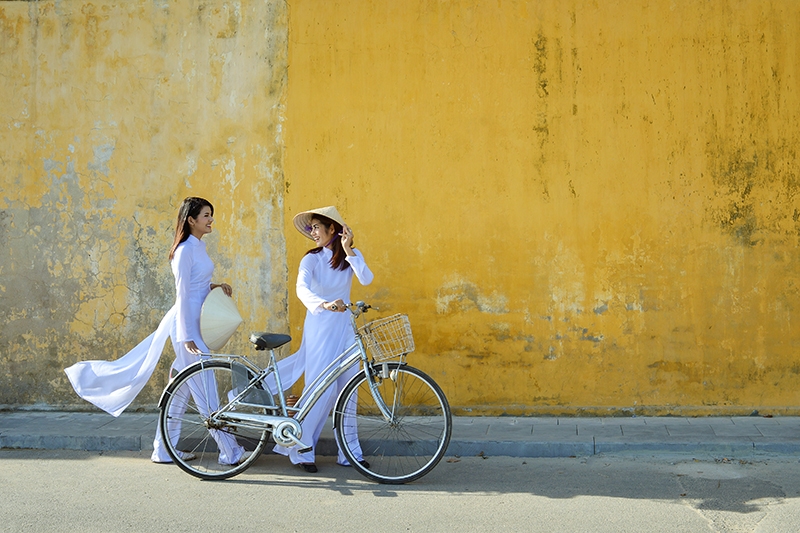
Traveling with
a child with a parent's surname If a child travels with a parent with a different family name, it can be checked whether there is actually a parent-child relationship. The purpose of this extra check is to prevent child abductions.
Some countries require a statement that the accompanying adult is actually the parent or has the authority. Inquire about this at the embassy or consulate of the country of destination. You can download a permission form on the Royal Netherlands Marechaussee website.
If a child is traveling with someone other than the parents, for example a family member, some countries require a declaration in which the parents give permission for this trip. You can inquire at the embassy or consulate of the country of destination about the admission requirements that apply to this country.

It is also possible to book only the land arrangement of this tour. You then arrange the international flights yourself and the transfer on arrival and departure. With the other participants you then make the journey according to program. This gives you the freedom to compose your own trip and choose the flight that suits your travel plans.
On the booking form you can also indicate whether we have to arrange an additional night on arrival for an additional fee. The transfer on arrival can also be arranged by Shoestring on an individual basis.
We need a minimum number of participants for all our trips. Keep this in mind before you book your own tickets.
In all cases, it is your responsibility to be present at the starting point of the journey on time. In addition, we are not responsible for sporadic changes in the departure dates of our group trips. For some periods the price of the land arrangement may deviate from the rest of the year, for example festival trips. When the price of the land arrangement is adjusted, this is mentioned under the 'latest news'.
Transport
This tour we have access to good private air-conditioned (mini) buses, so we can also stop at beautiful places in nature. The transfers from and to the airport are included. Any additional transportation costs for optional excursions are not included. On 'free days' the bus is basically not available.
You use the comfortable night train twice: from Hanoi to Hué.
The planned train time (subject to change!): Departure from Hanoi at 19.30 (or 20.10) hour / arrival Hué at 08.30 (or 09.40) hours.
The planned train time (subject to change!): Departure from Danang at 10.47 pm / arrival HCMC 4.05 pm.
In the night train you sleep in reserved couchettes in the second class in comfortable beds (air conditioned). A pleasant way to travel this long (and less interesting) journey distance! Breakfast is not included during the overnight train journey.
Other means of transport? The described boat trip in Ha Long Bay is included in your fare. Optionally, you can take a boat trip on the Perfume River at Hué or on the Thu Bon River at Hoi An. On site you can rent bikes at several places (for example in Hoi An or Siem Reap). The route from Ho Chi Minh City to Phnom Penh is taken by public bus. Fun is also an optional ride per cyclo (bicycle rickshaw) in Hanoi or by motorbike taxi (on the back of the driver) in Phnom Penh. Special in Siem Reap is a moped with trailer ( remorque moto ), with which the driver can possibly take you along the monuments of Angkor. Sufficient variation in transport means, here in Southeast Asia!
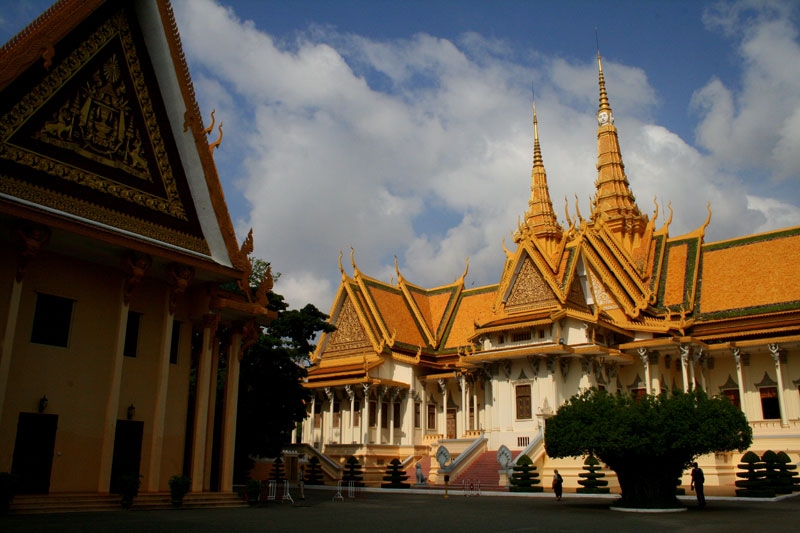
Travel distances from
Hanoi to Halong Bay: 170 km / 3 to 4 hours
Halong Bay to Hanoi: 170 km / 3 to 4 hours
Hanoi to Hué: 670 km / 14 hours (night train)
Hué to Hoi An: 130 km / 3 hours
Hoi An to Da Nang : 40 km / 3 quarters
Da Nang to HCMC: 900 km / 17½ hours (night train)
HCMC to Phnom Penh: 250 km / 6 to 7 hours
Phnom Penh to Battambang: 294 km / 5 hours
Battambang to Siem Reap: 175 km / 3 hours
NB: The mentioned 'bare' travel time per day is heavily dependent on traffic, road conditions, train delays, border formalities and weather. The travel time is of course approximate.
Accommodation
During the tour we stay in middle class hotels and guesthouses in double rooms, with private bathroom. Your stay is based on bed and breakfast. Most hotels have their own restaurant and sometimes a garden or a terrace. The check-in time at the hotels is usually 14.00 (if the rooms are ready earlier you can go in earlier), the check-out time is usually 12.00.
The hotels in Hoi An, Battambang and Siem Reap have a swimming pool; nice to wash off the tropical heat from you! In exceptional cases it may happen that another hotel without a pool has to be used. If this occurs, we will try to find a suitable alternative. Of course there are other swimming possibilities, think of the long coastline of Vietnam and the beautiful bay of Ha Long!
In Ha Long Bay you sleep one night on the boat. In the morning you wake up in an enchanting environment. Your lunch, dinner and breakfast on board are included (drinks are exclusive). NB: If the group is smaller than 6 travelers, you use a 'join in' transfer from / but the boat in Ha Long Bay. This means that other travelers (outside your group) can also sit on that bus and on the boat in Ha Long Bay.
Wifi is pleasant for many travelers to keep in touch with the home front via 'social media' . The planned hotels have Wi-Fi, sometimes for a fee, sometimes only in the lobby or bar of the hotel. Keep in mind that the quality and speed of the internet connection are certainly not optimal everywhere. No Wi-Fi is available on the boat in Halong Bay.
Travelers who - as many - individually register for a trip, share a double room with someone else. We naturally take into account that you come to the room of the same sex. If you want a room for yourself the whole trip, that can in principle be arranged. You pay the single room surcharge for this. There is no single room in the night train, as well as on the boat in Halong Bay.
Our trips are accompanied by well-trained local English speaking tour guides (in one case by Dutch-speaking travel guidance). We notice that our travelers greatly appreciate this, especially because these tour guides, in contrast to many of their Dutch colleagues, have more detailed knowledge of their country. He / she knows the area well, can give background information and ensures that the trip goes well. He / she knows how to act when something goes wrong, but is not a walking encyclopaedia. For that we would like to refer to a good travel manual.
Your tour guide expects a tip at the end, if she / he has done the job well. Shoestring pays the tour guides a wage that is on par with that of most adventurous travel organizations. Our guideline for the tip is € 1, - to € 2, - per traveler per day.
We often get the question whether a trip is 'heavy'. We find this a difficult question because the experience of the gravity of a journey is very personal. To give you an idea of the gravity of a trip, we have developed the following point system:
Category A: Light journey, for everyone to do well. Short travel distances, good hotels, travel at a low pace.
Category B: Good for everyone. Sometimes longer travel distances. Good hotels or camping facilities, sometimes adventurous accommodation, travel at an ordinary pace.
Category C: Good to do for everyone who prepares and is flexible. There are heavier trajectories in the journey, such as longer distances or walking routes. Multiple nights in simple accommodation.
Category D: Reasonably demanding journey through long journeys, usually primitive accommodation or tents and brisk walking tours.
This trip falls into category C and can be made by every fit person. You have to take into account some long bus rides. We usually stay reasonably comfortable. Keep in mind that the journey through Vietnam and Cambodia goes through developing countries, with a much lower standard of living than what you are used to at home. It is also possible that due to weather or poor road maintenance roads are temporarily impassable and we have to deviate from the route. A flexible and positive attitude is therefore more important than physical fitness. Go especially rested on a journey.

