


Round trip Vietnam and Cambodia

TOUR OPERATES: Round trip Vietnam and Cambodia
Day 1: Departure
Today you fly to Hanoi, where your Vietnam and Cambodia tour starts.
Day 2: Arrival Hanoi
You arrive in Hanoi. The tour guidance will take you away from the airport. Depending on the time you arrive, you still have some time to explore the city yourself after checking in at the hotel.
The city of Hanoi has its own unique atmosphere. The various lakes, scattered throughout the city, determine the image. The colonial villas give the city an unmistakable French touch; a grinding stomach will stop you with a 'la vache qui rit' pistol. The old town, north of the Hoan Kiem Lake, consists of numerous small, narrow streets which are inhabited by all kinds of craftsmen. At the shops pans are beaten, leather worked and silk or other were sold. You can wander around here for hours.
In the evening you can eat in one of the numerous restaurantsthat this city is rich. Although there are many nightlife options that remain open until the wee hours, it is not customary in Vietnam to go to bed late. Almost everything is closed around ten, eleven o'clock in the evening, to open early the next morning.
Day 3: Hanoi
Free day to discover Hanoi. The early birds among us can go to the nearby Hoan Kiem Lake around five or six in the morning , where you will see many Vietnamese people doing their morning gymnastics and tai chi.
There are several museums that are worthwhile. Of course you can not miss the Ho Chi Minh mausoleum during your Vietnam & Cambodia group trip. In the autumn, however, this mausoleum is often closed for several weeks in connection with the maintenance of the embalmed body of Ho Chi Minh. If you want to rest from the hustle and bustle of the city, you can do so at a cozy café on the Hoan Kiem lake.
You can wander endlessly through the old town where there is a huge activity. Brommertjes drive on and off. Everywhere are shops, restaurants, markets, temples, enough to look your eyes out.
In the evening you can possibly visit an authentic water puppet theater .
Day 4: Hanoi - Halong Bay
A 4½ hour (175 km) ride through the flat land of the Red River Delta brings you to the beautiful Halong Bay (the Bay of the Descending Dragon). The bay is listed as an 'indispensable landscape' on the UNESCO World Heritage List.
From the coastal town of Bay Chay we sail through Halong Bay. The centuries-old karst mountains have formed numerous islands and rockeries in the bay. Legend has it that they originated because a huge dragon landed in the sea, took part of the land with its tail and then let it disappear under water. Only the higher parts of the coast remained above the water. Whatever the case, Halong Bay is a spectacular natural phenomenon. There are caves that you can visit and the lovers can swim at a beach. You make a beautiful boat trip through this area. The food on the boat itself is usually an attraction in itself. You stay overnight at the junk.
Day 5: Halong Bay - Dong Trieu - Hanoi
In the morning you wake up in an enchanting environment. The boat takes you through the Halong Bay to the harbor.
You drive back to Hanoi via the 'pottery village' Dong Trieu. You have a short afternoon and evening in this big city. The total travel time for today is approximately five hours (176 km).
Day 6: Hanoi - Hué
You can choose to visit the Parfum pagoda in an optional excursion today . A ride of more than two hours will take you to the village where a rowing boat is waiting for you. This will take you through the rice fields, along pagodas and along the typical, pointed rocks of the karst mountains. After a walk of more than an hour, uphill, you finally reach the Perfume pagoda: a deep cave with countless Buddha statues . Keep in mind that you will have little or no time to freshen up before you board Hué in the night train.
Really on a journey TIP
At the end of the afternoon you leave with the night train to Hué. The train carries the appropriate name 'Reunification Express', as North and South Vietnam become so connected! Sleeping places have been reserved in advance. The sleeping compartments will be (as far as possible) in the 'soft-sleeved' part. Such a compartment consists of four beds. If there are too few places available, a number of participants will be accommodated in the 'hard-sleeper' section. Here each compartment consists of six beds that are slightly less 'luxurious' but still of sufficient quality to spend the night. Walk through the train and take a look at the 'hard-seat' section where travelers hang their hammocks in the evenings, or roll out their mats on the floor. Small refreshments and drinks are available on the train. There is also hot drinking water for tea or noodle soup.
The trains in Vietnam are running at a slow pace. When it is still light, you can enjoy the landscape. At some stations the train is stationary for a longer period of time because there is a need to wait for an oncoming train, because there is still a single track almost everywhere in Vietnam. You arrive in Hué the next morning.
Day 7: Hué
Day off. Hué is the former capital and seat of the Vietnamese emperors. In 1945 Bao Dai, the last emperor, was deposed. In Hué and surroundings there are several monuments that recall this glorious past. The former Imperial Palace, the Forbidden Purple City , is located in the center of the present city. The whole is reminiscent of the Forbidden City in Beijing, China, but in a smaller version. Unfortunately, Hué and the Forbidden City during the Tet offensive in 1968 suffered greatly from the shelling and bombing. However, with the help of various organizations, the Forbidden City is gradually being restored.
There are several monuments in and around Hué on the World Heritage List of UNESCO. For example, the Temple for the Tomb of Emperor Minh Mang, the complex of the Temple for Adoration of the Nine Nguyen Lords (Thai Mieu), the Tomb of Emperor Tu Duc, the pagoda 'Celestial Lady' (Thien Mu) and the complex of the Audience Palace (Dien Can Chanh). The tombs of the various emperorslocated along the Perfume River can easily be reached by bicycle. The tour guide can also hire a boat at the request of the participants to visit the most important tombs and pagodas in an excursion.
Day 8: Hué - Danang - Marble Mountains - Hoi An
Today you drive with our own bus with a number of stops to Hoi An. The distance from Hué to Da Nang (Danang) is not that long (180 km); more than four hours of buses are sufficient. If time permits, a stop at the Lang Co beach for a cup of coffee or tea. In that case, the journey time to Hoi An will take longer. Swinging, you follow the road over the Hai Van pass . On the left you have a view of the coast that alternately consists of rockeries and pristine bays with sandy beaches.
Before you travel to Hoi An, you can visit the Cham Museum in Da Nang as an optional extra. In this museum you can admire art treasures found at My Son.
Just after Da Nang you stop at the Marble Mountains(entrance fee not included). This is a rock formation in the flat land that is interlaced with caves and caverns. At the time of the Vietnam War it was a hiding place for the Viet Cong. Now it is a Buddhist shrine. The many images in the various caves are evidence of this.
The town of Hoi An has a rich trading past, witnessed by the many ancient Chinese houses and temples . A stroll through the town will introduce you to the beautiful Chinese architecture. Several residents of these monumental houses have opened their homes so you can also view the old splendor. The 'old city' of Hoi An has been placed on the World Heritage List by UNESCO.
Day 9: Hoi An / Excursion My Son
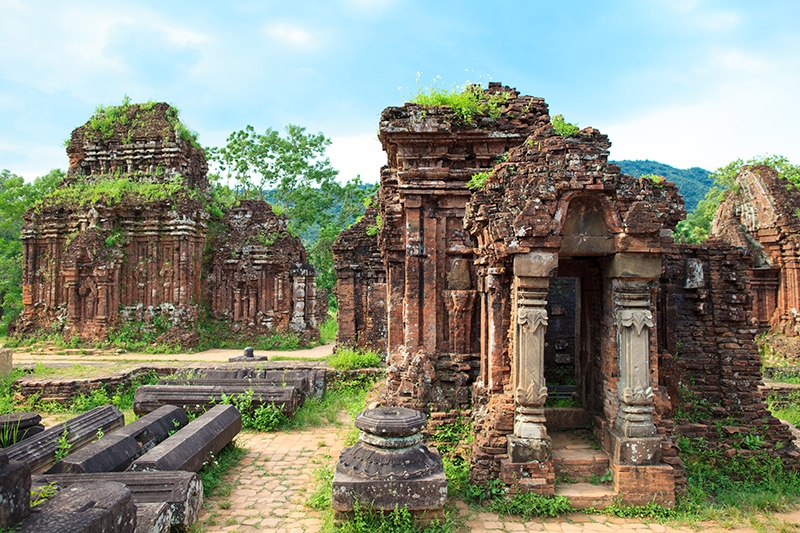
Day off. Enthusiasts of excavations will definitely visit during this Vietnam and Cambodia group trip to My Son , which also adorns UNESCO's World Heritage List. The eponymous ruins are about thirty kilometers from Hoi An. With a rented car this place is easy to reach. My Son was the political and religious center of the Chamfol people who ruled Vietnam from the fourth to the thirteenth century. Although here too the war has left its mark, it is still an interesting and atmospheric place to visit. For this trip to My Son you need at least half a day.
If you do not like excavations, you can spend a day at the beautiful Cua Dai beachSpend a boat trip on the Thu Bon River to one of the industrial villages.
Day 10: Hoi An - Da Nang - Ho Chi Minh City
In the morning you drive to Da Nang, from where you take a flight to Ho Chi Minh City.
Saigon (Sai Gon), officially known as Ho Chi Minh City since 1975, is the commercial center of the country. Ho Chi Minh City has more than seven million inhabitants and is a busy, noisy city where old and new influences intermingle. There is a lot to see here.
In Ho Chi Minh City you will find the former American embassy on Le Duan street. Almost everyone will remember the dramatic departure of the Americans from the roof of the embassy on April 30, 1975. Also in this city is the former presidential palace. Striking are the Notre Dame Cathedraland the Hoofdpostkantoor that clearly shows French influences. In the Dong Khoi street (formerly Rue Catinat) the famous writer Graham Greene rented an apartment.
Cholon, 'big market', is the district where most of the Chinese live and where countless Chinese temples and houses can be admired. In Cholon is the largest covered market of Ho Chi Minh City , where the most diverse items are for sale. Also interesting are the Thien Hau pagoda and the Ngia An Hoi Quan Pagoda. Ho Chi Minh City also has several interesting museums that tell you a lot about the history of the country.
Day 11: Ho Chi Minh City / Tay Ninh and Cu Chi tunnels
Free day in Ho Chi Minh city. Who wants to join an optional excursion to Tay Ninh and Cu Chi. This excursion to Tay Ninh and Cu Chi takes a full day.
In the morning you leave with your own bus to Tay Ninh. This colorful temple complex is the center of the Cao Dai religion. The Cao Dai is a new religion that came into being in 1926, which, according to the Vietnamese founder and medium Ngo Minh Chieu, best from the religions of East and West (Buddhism, Taoism, Confucianism, Christianity, Islam, spiritism and ancestor worship). There is one god, Cao Dai. During séances, media provide contact with the god and the spirit world. The medium received messages from the other side in the many séances: Buddha, Jesus, Lao Tse, Confucius and Mohammed. But also of the spirits of Joan of Arc, Napoleon, Churchill, Victor Hugo and Shakespeare, among others. There is a church hierarchy like in the Roman Catholic Church: a pope, cardinals, bishops, priests. The colors of their legs differ from the other followers. At the moment there are more than 2 million followers, especially in South Vietnam. The center of the Cao Dai is in the city of Tay Ninh, 100 km from Ho Chi Minh City. Every six hours a service takes place here with a ceremonial and meditative part. Your departure from Ho Chi Minh City is chosen so that you can attend the service from noon.
Then it is time to go to the tunnel complex of Cu Chito drive. Of course you stop en route to lunch and for example enjoy a nice bowl of 'phó' (noodle soup). The tunnels of Cu Chi were used by the Viet Cong in the war to resist the Americans. Already in the Franco-Vietnamese war a start was made with the construction of these tunnels, hand-carved by the Viet Minh (!). The final complex consisted of a total of approximately 240 kilometers of tunnels. The tunnels are divided over different floors, including underground hospitals, kitchens and other facilities. Through the tunnels the surrounding villages were connected and the movements of the American troops could be monitored. During the years of struggle that the Viet Cong fought against the American and South Vietnamese army, the opponent never succeeded in discovering or conquering the entire tunnel system. It is still possible to descend into the tunnels and experience a little bit how people lived, suffered and fought here.
Late in the afternoon you will return to Ho Chi Minh City after about two hours, where you can use the evening and possibly the night to discover that a city like Ho Chi Minh City never sleeps. There is always something going on here.
Day 12: Ho Chi Minh City - Can Tho (Mekong Delta)
By bus you travel in five hours (230 km) to Can Tho, the only university city of the Mekong Delta . Along the way the picturesque countryside of the delta is clearly visible. The inhabitants grow rice, coconut, bananas, mangoes, longans and citrus fruits. There is also fish farming and fishing. Because of its pivotal role in (water) traffic in the delta, Can Tho functions as a regional capital in this area. The great activity can be observed on the Can Tho market. Not only vegetables, fruit, rice, fish and meat are traded, but also electronics, textiles and books.
The way to explore the Mekong delta is of course by boat. You could participate in an optional excursion where you take a boat trip and you can get a better picture of the daily life in the delta - of the houses that are built close to or in the water, of the villagers who are fishing or who use the river water to do their laundry, or the silence that can prevail in the countryside. You spend the night in Can Tho.
Day 13: Can Tho - Chau Doc (Mekong Delta)
By bus you travel today to Chau Doc in about 2½ hours (90 km) . Chau Doc is one of the largest places in the Mekong Delta. Now it is mainly a commercial center, once famous for its authentic canoeing competitions. Both Chinese, Khmer and Chambers are well represented in Chau Doc. You will also find mosques, catholic churches and temples next to each other.
Really on a journey TIP
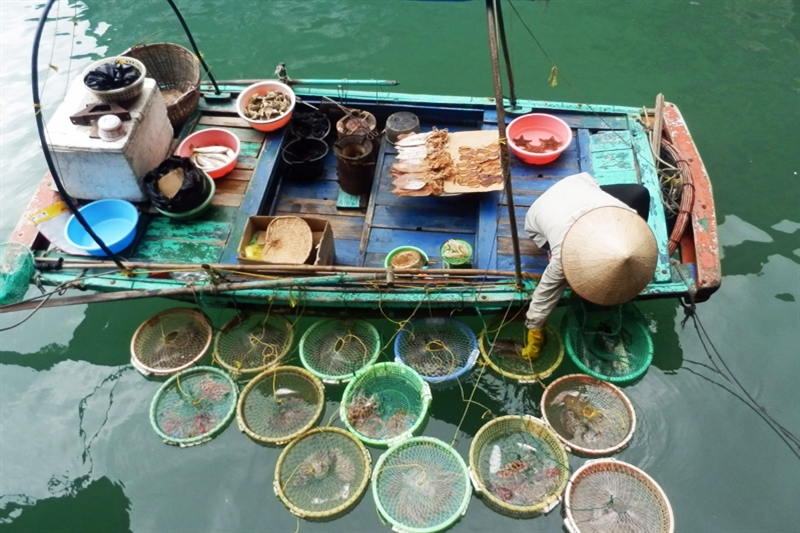
Around Chau Doc floating houses can be seen everywhere . These houses float on empty metal barrels and serve both to live in and to provide their food: underneath the houses is a fishing net tensed, in which the stock of fish caught by these inhabitants is kept. The fish stay fresh in their natural environment, are fed with the kitchen waste and - when the time comes - are very easy to catch. Enjoy your last delicious meal in Vietnam, before you sail to Cambodia the next day.
Day 14: Chau Doc - Phnom Penh
Today you sail by boat to Phnom Penh, the capital of Cambodia. With its more than two million inhabitants, according to legend, the city was founded in 1372 by a rich lady named 'Penh'. 'Phnom' is the Khmer name for 'mountain'. Since then, the city has retained this name.
In 1975, virtually the entire Phnom Penh was evacuated on the orders of the then leader Pol Pot. Her residents were sent to the countryside in the context of re-education. Phnom Penh became a ghost town and was largely destroyed. The Tuol Sleng prison and the Choeung Ek , better known as Killing Fields, testify to the horrendous rule of Pol Pot and his Khmer Rouge.
NB. This is the day you cross the Vietnamese-Cambodian border at Chau Doc.
Day 15: Phnom Penh
Day off. In recent years, Phnom Penh is fast becoming a sophisticated city. The city is expanding rapidly. What remains unchanged is that the Royal Palace and the Silver Pagoda still look out on the banks of the Tonle Sap River. A visit to the Historical Museum or the Wat Phra Keo, a unique building that was rebuilt by King Sihanouk and which contains 5,800 kilograms of silver, is certainly worthwhile. In this temple you will also find a Buddha made of ninety kilos of pure gold, invested with ten thousand diamonds. Near the 'silver temple' with a floor of silver stones, lies the royal palace that can be visited for a part.
Those who still want to buy some souvenirs, should certainly not miss a visit to the Russian market. You will find everything: from earthenware bowls to hammocks, silk fabrics and silverware. On this market are many local restaurants where you can eat delicious. The central market in Art Deco style is always full of life and in the middle you have a large department with gold and jewelery stalls.
Day 16: Phnom Penh - Battambang
Today you continue your group trip on highway no. 5 which, it seems, is constantly being repaired. For Cambodian concepts, however, this is a great motorway. Where you used to do more than ten hours over the 291 kilometers, you do this ride now in four to five hours.
The landscape will not bore you for a moment, besides the endless rice fields we see the traditional life of the Khmer, which gradually improves. Battambang,Cambodia's second largest city on the Sangker River, is known for its well-preserved French colonial architecture. This little tourist city was difficult to access until 1998 due to the presence of Red Khmers, but for a number of years this charming city can revive.
Battambang is a very typical Cambodian city , which is still little included in travel programs. By bike or by moped you can explore the nearby rural life. From the hills on which the Phnom Sampeau pagoda and the Angkorian Wat Banan are built, you have a magnificent view over the rice fields. The Kamping Poy reservoiris a popular picnic area for Cambodians. You can also take a refreshing dip in the water here. In the evening you can join one of the many food and drink stalls.
Day 17: Battambang - Siem Reap / Angkor
Today you will drive to Siem Reap in about 3½ hours (165 km). After arriving in Siem Reap you can be massaged by the blind of the Angkor Massage Institute. You stay in a hotel with swimming pool (with reservation), nice to wash away the heat of the tropics.
Siem Reap has a nice covered market where you can eat delicious Cambodian food in the food stalls. Try 'amok', a creamy fish curry served in a coconut.
Siem Reap is the base for the exploration of one of the largest and most beautiful temple complexes in Southeast Asia, that of Angkor. This gigantic complex of no less than 110 temples is considered one of the architectural world wonders. The temples have been built up over the course of hundreds of years by various rulers of the Khmer empire. Over the centuries, however, Angkor has 'disappeared' into the jungle, fallen into oblivion and overgrown with vegetation. At the end of the nineteenth century, the temples located in the middle of the jungle were rediscovered.
Please note: For a visit to the temple complex of Angkor Wat you buy a strictly personal admission ticket at the entrance. A 1-day access pass costs 37 US $, for 3 days you pay 62 US $ (price changes subject to change).
Day 18: Siem Reap / Angkor
You have two full days off to view the dozens of monuments. You can do this by motorcycle taxi or, even more fun, with a remorque moto , a moped with a trailer. Some of the beautiful temples have been restored, others are partly overgrown by the jungle. Certainly in these temples with their many engravings there is a mystical atmosphere. Gigantic forest giants in the Ta Prohm temple encircle the boulders, temple walls and roofs, and thick tree roots that grow thick through the ruins.
There are dozens of temples that you can visit, but do not miss Angkor Wat, Angkor Thom and Banteay Srei. The famous Angkor Wat was built by King Suryavarman II and was dedicated to the Hindu god Vishnu in the 12th century. This imposing temple is most beautiful at sunset and sunrise. At dusk you can look out over the wooded area from the Bakheng Temple, near Angkor Wat, where you have a beautiful view of Angkor Wat.
Angkor Thom consists of the Bayon Temple, built by King Jayavarman VII at the end of the 12th century. Penetrating stone faces look at you. In the middle of the Bayon Temple you can see a statue of Buddha with Vishnu on its side to the West and Shiva to the east. At sunrise, this temple is best shown by the specific light incidence.
Day 19: Siem Reap / Angkor
Day off. This day you could spend to visit a number of temples that are further away. If you want to visit Banteay Srei , you first have to make a trip of about thirty kilometers through the rice fields. The size of the temple itself is perhaps not the most impressive, but the special color and detail of the many reliefs and sculptures in the complex belong to the most refined of Angkor.
Another recommendation is a visit to Phnom Kulen and Kobal Spien or to the Beng Menglea in the jungle. You are busy all day.
When you are tired of the temples, the tour guide can organize an excursion to Preak Tuol, a protected bird sanctuary with aunique ecosystem for rare water birds and amphibians . You can also make an excursion by motorboat to a floating village with its floating schools, shops and restaurants and slowly let the strange flooded forests slide past you.
Day 20: Departure Siem Reap
Today you fly from Siem Reap with a switch to the Benelux where you arrive the next day and your Vietnam and Cambodia tour ends.
Day 21: Arrival
Depending on the flight schedule, it may happen that in the evening of day 20 you fly from Siem Reap to Bangkok and fly by day flight from Bangkok to Amsterdam / Brussels on day 21, where you will arrive the same day. In this case an overnight stay is offered by us in a hotel near the airport of Bangkok (day 20 - 21).
It also happens in a very few cases that the day flight from Siem Reap, with a transfer, to the Benelux takes place in its entirety on day 21. In that case you spend an extra night at Siem Reap (day 20 - 21),
Travel documents
If you have Dutch or Belgian nationality, you will need a visa for Cambodia and Vietnam for this trip.
On the website of our partner Visumloket you will find all information about the necessary travel documents (such as passport), visa, the visa procedure to be followed and the location of the embassy. Begin 4 to 6 weeks before departure of your trip with the application.
For the Vietnam visa: if you have the required visa arranged through us, we will charge, in addition to the visa costs, € 30, - agency fee per person per visa. You do not have to go to the relevant embassy (s) twice yourself.
For the Cambodia visa: if you have the required visa arranged through us, we will charge, in addition to the visa fee, € 40, - mediation costs per person per visa for Dutch travelers. We charge € 30, - mediation costs to Belgian travelers. You do not have to go to the relevant embassy (s) twice yourself.
You can also purchase the visa for Cambodia on the spot at the border crossing. Make sure you have enough dollars and passport photos with you. Please note that arranging the visa on site can take a lot of time when it is busy. We therefore recommend to arrange the visa before departure.
Land arrangement
It is also possible to book only the land arrangement of this tour. You then arrange the international flights yourself and the transfer on arrival and departure. With the other participants you then make the journey according to program. This gives you the freedom to compose your own trip and choose the flight that suits your travel plans.
On the booking form you can also indicate whether we have to arrange an additional night on arrival for an additional fee. The transfer on arrival can also be arranged by Koning Aap on an individual basis.
We need a minimum number of participants for all our trips. Keep this in mind before you book your own tickets.
In all cases, it is your responsibility to be present at the starting point of the journey on time. In addition, we are not responsible for sporadic changes in the departure dates of our group trips. For some periods the price of the land arrangement may deviate from the rest of the year, for example festival trips. When the price of the land arrangement is adjusted, this is mentioned under the 'latest news'.
Additional costs and pocket money
Pocket money / Additional costs
The amount recommended by us is used to pay for your meals, excursions, entrance fees, tips and the common expenses. The amount that you ultimately spend depends, of course, on your own spending pattern; souvenirs are therefore not included.
Joint spending pot
During your trip you can regularly join the group in excursions or (non-prepaid) meals. Some tips and entrance tickets can also be paid here and there. In order not to have to pay for this each time separately, a joint expenditure pool is set up for convenience. At the start of the journey, € 100, - will be collected by the tour guide for this pot. At the end of the journey, you will then receive the settlement (in which you will see), where you will receive or reimburse your money. These expenses are taken into account in the size of our advice amount for the pocket money.
Accommodation and transport
Transport
During this trip you use a wide variety of means of transport. You travel the largest part of the journey with buses that are rented specifically for our group. So you can stop at any time and at any place to take photos or try a local snack (if time permits). The bus is not available on 'free days'.
A comfortable domestic flight will take you from Danang to Ho Chi Minh City.
Of course there are plenty of opportunities to get acquainted with other means of transport such as the train (Hanoi-Hué) and the boat (eg in Halong Bay, over the Perfume River at Hué and in the Mekong Delta). On the spot you can often rent bikes and you can also take a ride in the cities by bicycle rickshaw, which is called cyclo here. You can also walk to your heart's content to get a good impression of the countries you travel through.
If you book the land arrangement, your trip starts in Hanoi (day 2) and the trip ends on day 20 in Siem Reap.
Accommodation
During this trip we stay as much as possible in hotels with double rooms with shower and toilet. In the selection of our hotels, we especially paid attention to location, hygiene and atmosphere. The hotels or guesthouses are generally situated in the center of the place where we stay. You stay on a bed and breakfast basis.
In Halong Bay you make a beautiful boat trip. You sleep here one night at a junk! Lunch, dinner and breakfast are included in the cruise. The stay on the junk is on ' join in ' basis; sometimes other travelers may be present on the boat (outside of your own King Monkey group). It is possible that due to bad weather conditions an overnight stay on board is not allowed. In that case, we deviate to a hotel on the coast.
You sleep one night in the night train, from Hanoi to Hué. Sleeping places have been reserved in advance. The sleeping compartments will be (as far as possible) in the ' softsleeper ' part. Such a compartment consists of four beds. If there are too few places available, a number of participants will be accommodated in the ' hardsleeper ' section. Here each compartment consists of six beds that are slightly less 'luxurious' but still of sufficient quality to spend the night. No meals are included in the night train.
The planned hotels in Hué, Hoi An, Battambang and Siem Reap have a swimming pool; nice to wash off the tropical heat from you! In exceptional cases it may happen that another hotel without a pool has to be used. If this occurs, we will try to find a suitable alternative. Of course there are other swimming opportunities during this trip; think of your stay in Halong Bay and also the beach in Hoi An is not far away!
Most hotels use an 'çheck out' time of 12 noon. To make your stay more comfortable, we arrange a few 'day rooms' for the group in Hanoi (day 6) and in Siem Reap (day 20), as you will not travel until the end of the afternoon / in the evening. You have the opportunity to refresh yourself. The use of the shared day rooms (an average of 4 people per room) is until 6 pm.
Wifi is pleasant for many travelers to keep in touch with the home front via 'social media'. All hotels scheduled on this tour through Vietnam have Wi-Fi, sometimes for a fee, sometimes only in the hotel lobby. Please note that the quality and speed of the internet connection are not optimal everywhere. No Wi-Fi is available on the boat in Halong Bay.
Participants who register individually share a room with another participant. We naturally take into account that you come to the room of the same sex. It is possible to book a single room. A single room is not possible in the night train. If you book a single room, the single room surcharge will be charged.
Travel guidance
All our group tours are carried out on the spot by Dutch-speaking (or in the case of our trips in Southern Africa African-speaking) travel guides. King Monkey makes high demands on the tour guide; after all, a journey stands or falls. Important criteria in selecting our travel guides are: (obviously) extensive travel experience, experience in dealing with groups and - preferably - active knowledge of a local language. Special training courses prepare the tour guides for what the participants expect from them. Our employees learn what the King Monkey travel formula stands for. They are not only instructed from our office, but also follow a multi-day course where they are presented with many (sometimes difficult) practical cases. A great opportunity to exchange essential experience. At some destinations local Dutch speaking tour guides are deployed by our local agents. These tour guides are also trained on site by the agency. We evaluate the functioning of our travel guides after each trip on the basis of evaluation forms completed by participants. In this way we always have an overview of how our people operate in the field!
The primary task of our travel guidance is to ensure good logistics of the journey (transport and accommodation). The tour guide also monitors the progress of the program and the attention given to each component. The tour guide organizes a range of optional excursions on the spot. In addition, he or she naturally functions as a central source of information. Our employees can tell a lot about the country and local customs.
Of course, a tour guide does not have everything in hand. Sometimes there is force majeure: the road has been blocked by flooding or landslides, the government has confiscated the train tickets or the hotel has already given away the rooms. In this type of setbacks, the tour guide will look for an alternative. Despite all the preparations and efforts of the tour guide, it may happen that the trip does not go entirely according to your expectations. The tour guide would like to hear from you, so that a solution can be found on the spot.
Your tour guide expects a tip at the end, if she / he has done the job well. King Monkey pays the tour guides a wage that is on par with that of most adventurous travel organizations. Our guideline for the tip is € 1, - to € 2, - per traveler per day.
Finally, you can always contact the tour guide if there are problems. Realize: a travel companion is not a walking encyclopedia. It is always wise to bring a good travel handbook.

